

By CAPT Mark Poster, CMI
The Navigation Rules of the modern age are similar to the rules of the road on the highway, with collision avoidance between vessels as their primary purpose. These nautical rules establish a consistent way to navigate safely and avoid collisions when two boats find themselves in one of the three addressed encountering situations: overtaking, head-on, or crossing one another.
The Navigation Rules are federal and apply on “navigable waters of the United States;” however, they may also be incorporated into state law. A recent study found that 37 of the 56 States and Territories had either adopted the International Rules or Inland Rules, or enacted laws requiring conformity with them.
The difference between laws (statutes) and regulations is sometimes misunderstood. Congress, and only Congress, enacts laws. The Motorboat Act of 1940, the Federal Boating Act of 1958 and the Federal Boat Safety Act of 1971 are all examples of laws which were enacted by Congress in the pursuit of enhancing recreational boating safety.
The International Rules were formalized in the “1972 Convention on the International Regulations for Preventing Collisions at Sea”, also known as the “Collision Regulations”, or more commonly, “COLREGS”.
Both the COLREGS and Inland Rules are codified within our Code of Federal Regulations under Title 33 CFR. The specific boundary lines that define which set of rules mariners shall comply with are called “Demarcation Lines” and are identified on nautical charts in pink. The COLREGS apply on the seaward side, and the Inland Rules apply on the shoreward side. But what if two vessels are approaching each other from opposite sides of the Demarcation Line? Don’t different rules apply for each vessel? One of the major differences in the two sets of rules is what the sound signals imply, specifically in that the COLREGS signals indicate “execution” (I am turning to starboard) as opposed to the Inland Rules which indicate “intent” (I intend to leave you on my Port side). The first is declaring an actual turning maneuver whereas the second may not include a change of course, even though the resulting encounter may be the same, such as in a port to port passing.
The two sets of Rules are similar in both content and format but do have some crucial differences. They both use terms that are not clearly defined, which can be interpreted quite differently depending on the circumstances, including the types of vessels and/or the characteristics of the body of water involved. Courts and case law may determine how the specific term(s) apply while considering situation-specific situations and factors. Keep in mind that the Navigation Rules apply to all vessels, from ultra large cargo ships to personal watercraft, on every type of waterway, in all conditions.
Not surprisingly, there are critics of the Rules regarding the actual wording and the lack of specific definitions of terms. Not to mention that some situations are not even addressed, such as three vessels approaching each other, and two vessels backing out of their slips at the same time. Let us explore some of these terms in use that are undefined that may have been, or will be, interpreted by the courts or previously established by case law.
Rule 2 Responsibility Some of the terms that are not specifically defined in the rules start with Rule 2 (a) Responsibility, which states “…the neglect of any precaution which may be required by the ordinary practice of seaman”. The term “ordinary practice” may refer to the common sense and time-tested practices that seamen have followed for years as a precautionary measure to ensure safe navigation, although they are not explicitly listed. Examples would include maintaining a proper lookout, keeping clear of other vessels, and proceeding at a safe speed, all of which are essential for maintaining a safe maritime environment. Other considerations would include taking into account the vessels’ maneuvering characteristics, the depth of the water, traffic density, visibility and the water surface conditions. The list could be quite extensive and could move into the realm of “good or proper seamanship”. Still, no proper definition of “ordinary practice” nor of “seamen” is offered. The question begs the question if any experience or qualification applies to the term “seamen”, in other words, is a first-time rental boat operator considered a seaman? In all cases obedience in following the rules is the test of good seamanship, whereas disregard of the rules constitutes and is evidence of poor seamanship.
Rule 3 General Definitions The first “quirk” in Rule 3 (a): “The word “vessel” includes every description of water craft, including non-displacement craft, WIG craft and seaplanes (italics added), used or capable of being used as a means of transportation on water.” A seaplane is an amphibious aircraft that can take off and land both on runways and water, with the bottom of the fuselage designed as a boat hull. Almost as an afterthought, included in Rule 3 is a further clarification, or additional definition in section (e): “The word “seaplane” includes “any aircraft designed to maneuver on the water.” So now we include floatplanes which rely on floats (pontoons or sponsons) mounted under the fuselage (which remains above the water) and are most often seen on smaller aircraft. This additional definition does allow for any future craft not yet designed or in use that may fit within the description, autonomous or otherwise.
Many, but certainly not all terms are defined in Rule 3 Definitions, and the application of many undefined terms will rely on the situation-specific factors of each case. The two sets of rules do have some unique variables. Only the International Rules contain the term “vessel constrained by her draft” in Rule 3 (h), while only the Inland Rules contain the term “right of way”, used in both Rules 9 (a) (ii) Narrow Channels and Rule 14 (d) Head-on Situation, as they only apply to power-driven vessels on rivers while proceeding downbound with a following current. These are the only two situations that the term “right of way” technically applies. The proper terminology for all other vessel encounters is Stand-on and Give-way, except in Rule 14 Head-on, where both vessels are Give-way.
Rule 3 Definitions (International (k) and Inland (j)) “Vessels shall be deemed to be in sight of one another only when one can be observed visually by the other.” In this case, if vessel 1 claims to see vessel 2, and vessel 2 claims not to have seen vessel 1 resulting in a collision, a violation for vessel 2 of Rule 5 Look-out exists, as visibility (being in sight of and can be observed by) goes both ways via line of sight. The term “deemed” means “considered”.
Rule 5 Look-out is the first rule that the term “risk of collision” is used, and is also prevalent in several other Rules, including; Rules 7 Risk of Collision, 8 Action to Avoid Collision, 12 Sailing Vessels, 14 Head-on Situation, 14 Crossing Situation, 18 Responsibility Between Vessels, and 19 Conduct of Vessels in Restricted Visibility. This is a critical concept indicating the likelihood that two vessels may collide. Most mariners are familiar with the term “Constant Bearing/Decreasing Range”, which can be said to be the recipe for a guaranteed collision. Conversely, when two vessels approach each other at a speed and/or distance whereby any maneuvering by either will have no effect on the other, there is no risk of collision. However, if any maneuvering by one or the other will have an effect on the other vessel involved, there very well may be, or develop into, a risk of collision during the approach. Once there is a risk of collision, several other rules are triggered and apply.
Rule 8 Action to Avoid Collision utilizes the term “close-quarters”, which may appear to be quite subjective at first glance, as it is not possible to denote a specific distance at which an encounter would be deemed as close-quarters. As in many situations, the risk factors would be applicable in a given circumstance and will be determined on a case-by-case basis, possibly relying on another undefined phrase, i.e. “safe passing distance”. The concept of safe, defensive driving – or operating – is during any type of encounter, regardless of the other vessel’s unexpected maneuver (or loss of steering), your distance from the other vessel precludes the possibility of a collision.
Rule 9 Narrow Channels include the terms “nearing a bend or an area of a narrow channel or fairway” in both sets of rules. A bend used in this context means a change of course on a river or waterway. The term “channel” includes “the part of a body of water deep enough for navigation through an area otherwise not suitable” and “the deepest part of a stream, bay or straight, through which the main current flows”. According to Bowditch American Practical Navigator, the definition of “fairway” is “1. The main thoroughfare of shipping in a harbor or channel. 2. The middle of a channel.” A fairway can be a buoyed channel through otherwise open water, not necessarily constricted by any other boundaries. They are often marked by buoys, but they need not be prominently marked by buoys or dayshapes.
Rule 9 (f) refers to the sound signal requirement in Rule 34 (e) of one prolonged blast, often referred as the blind-bend signal, “where other vessels may be obscured by any intervening obstruction in a narrow channel or fairway that may obscure other vessels”, and “when a vessel is approaching any obstruction in a narrow channel or fairway that may obscure other vessels”.
Rule 13 Overtaking clearly states that “when coming up with another vessel from a direction more that 22.5 degrees abaft her beam” she is overtaking, and if there is “any doubt to assume this is the case and act accordingly” ensuring her “duty of keeping well clear of the overtaken vessel until she is finally past and clear”. This rule is well defined, unlike the next two rules as we shall see.
Rule 14 Head-on Situation includes the following language: “meeting on reciprocal or nearly reciprocal courses so as to involve risk of collision” and “sees the other vessel ahead or nearly ahead and by night she would see the masthead lights of the other in a line or nearly in a line and/or both sidelights”. This begs the question of at what relative bearings does this encounter become a crossing situation, especially considering that vessels may not, or do not perfectly track due to environmental influences and may “yaw” or “waver” from their overall “tracking” courses? Smaller craft are more susceptible to this yawing effect.
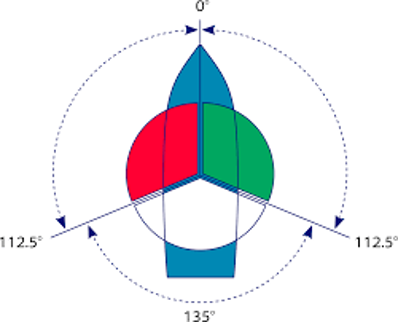
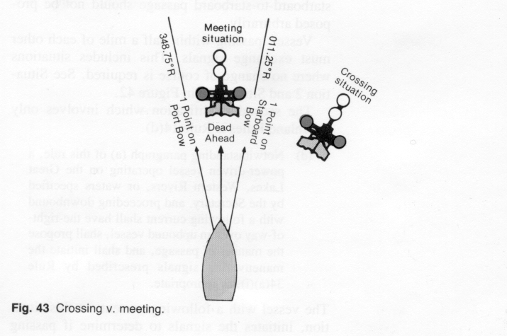
Rule 15 Crossing There are two interpretations that delineate when a vessel is either in a Head-on or a Crossing situation, although they are not specified in the Rules. For these interpretations we must use the Points of the compass i.e. each Point is equal to 11¼ degrees. We know that the term “2 Points abaft the starboard beam” is equal to 112.5 degrees (90 degrees is abeam plus 2 Points (or 22.5 degrees) equals 112.5 degrees), which is exactly the arc of visibility of the starboard navigation light. This is the line of the relative bearing that determines if the approaching vessel is either crossing (within that arc of visibility) or overtaking (behind the starboard arc, and within the sternlight’s 135 degree arc of visibility) as seen in the first diagram. Working backwards, one of the interpretations is that if a vessel is within one Point of the bow (or about 5 to 6 degrees to either side of dead ahead), then this is a Head-on situation according to one reference. Another reference has conflicting information in that it indicates that less than one full Point to either side is a Head-on situation as seen in the second diagram. If the approaching vessel is more than the full point of 11¼ degrees off the bow or dead ahead, it is a crossing situation. I shall not make a determination as to which of these two interpretations may apply, as the courts may factor in the size and/or handling characteristics of the vessels involved in making their conclusions.
Rule 14 has similar language to Rule 13 as to if there is any doubt: “she shall assume that it does exist and act accordingly”, which appears to imply that both vessels must Give-way as they are in a Head-on situation. It should be noted that Rule 15 Crossing does not include the “doubt clause” that is included in Rule 13 Overtaking and Rule 14 Head-on. This means that if there is any doubt if they are in a crossing vs meeting (head-on) situation, to assume that it is a head-on situation and to act accordingly as both will be give-way vessels. Simerly, if in doubt as to whether the encounter is a crossing vs overtaking situation, to assume an overtaking situation and each act accordingly: stand-on shall maintain course and speed and give-way shall keep clear. But let us not forget that Rule 7 Action to Avoid Collision states “If there is any doubt such risk (of collision) shall deemed to exist”.
Larger vessels with required AIS transponders (Automatic Identification Systems) that indicate the vessel’s identity, position, course and speed make actions preceding a collision available to investigators, unlike on smaller recreational craft that may not carry record keeping navigation systems.
Rule 17 Action by Stand-on Vessel (a)(ii) The term “take action to avoid collision by her maneuver alone” needs some clarification. What does “maneuver” mean in this context; both change of course and speed reductions? A change of course can be more easily discerned than a reduction of speed, which is far less noticeable – and may take considerably more time before they take effect. Speed reductions by the Stand-on vessel may be ineffective or even counterproductive. In all cases the proper sound signals must be provided to help alleviate confusion but does not relieve the Give-way vessel of her obligation to keep out of the way.
Rule 19 Conduct of Vessels in Restricted Visibility applies to vessels not in sight of one another when navigating in “or near” an area of restricted visibility. The term “in” is self-explanatory, however, the term “or near” is vague and open to debate. The unwritten rule for operating in restricted visibility is to proceed at a speed where the vessel can be stopped in less than half the distance of visibility, thus if both vessels are following this guideline, a collision can be avoided. Conditions of restricted visibility means any condition in which visibility is restricted by fog, mist, falling snow, heavy rainstorms, sandstorms, or any other similar causes. As a vessel departs any of these conditions and enters better visibility conditions, a vigorous effort of look-out should be performed to confirm there is no risk of collision. Because radar, thermal, FLIR and other systems may be affected by these conditions, using binoculars may be the best way to perform a proper look-out as visibility conditions improve. Adherence to Rule 35 Sound Signals in Restricted Visibility is not optional and “shall” be followed to alert others of your presence.
Rule 34 Maneuvering and Warning Signals have some major differences between the COLREGS and Inland rules, primarily that the COLREGS signals express an execution maneuver, as in “I am altering my course to port (or starboard)”, whereas the Inland rules signify an intention, which may or may not result in a change of course, such as “I intend to leave you on my port (or starboard) side”, and apply when meeting or crossing within a half mile of each other. Both sets of rules include the term “I am operating astern propulsion” by sounding three short blasts. What is not explained in the rules is that when a vessel is moving forward and shifts gears into reverse/astern propulsion, the vessel will continue moving forward for a bit until the forward motion is slowed, then stopped, and then begins actually traveling in the opposite direction. She is however, still obligated to sound the proper signal as soon as she is operating in astern propulsion, even while moving forward.
It should also be noted that the five short and rapid blasts, previously known as the “Danger Signal” has been eliminated from the rules and no longer applies. This signal now indicates when, from any cause, either vessel fails to understand the intentions or actions of the other or is in doubt whether sufficient action is being taken by the other to avoid collision, the vessel in doubt shall immediately indicate such doubt by giving this signal.
Rule 35 Sound Signals in Restricted Visibility (b) states “A power-driven vessel underway but stopped and making no way through the water…”. The term “underway” means not docked, or made fast to the shore, or anchored, (unless the anchor is dragging), i.e., free-floating. “Stopped” indicates no use of propulsion. “Making no way through the water” is the part that is open to debate, as over time, any free-floating object will move over a geographic point, making this hypothetical situation (“underway but not making way”) utterly impossible to achieve, unless a moment of time is introduced into the equation.
Rule 36 Signals to Attract Attention “If necessary to attract the attention of another vessel, any vessel may…direct the beam of her searchlight in the direction of the danger in such a way as not to embarrass any vessel.” No guidance is provided in the rules on how to perform this act of goodwill “in such a way as not to embarrass any vessel.”
In closing, as in so many cases involving Navigation Rule violations, there may be issues of concern that require some interpretation by the courts. It is therefore, up to the expert to become intimately familiar with the nuances of the Rules, and to provide a cogent analysis and proper arguments to strengthen the side to which they are representing.