

By CAPT Mark Poster, CMI
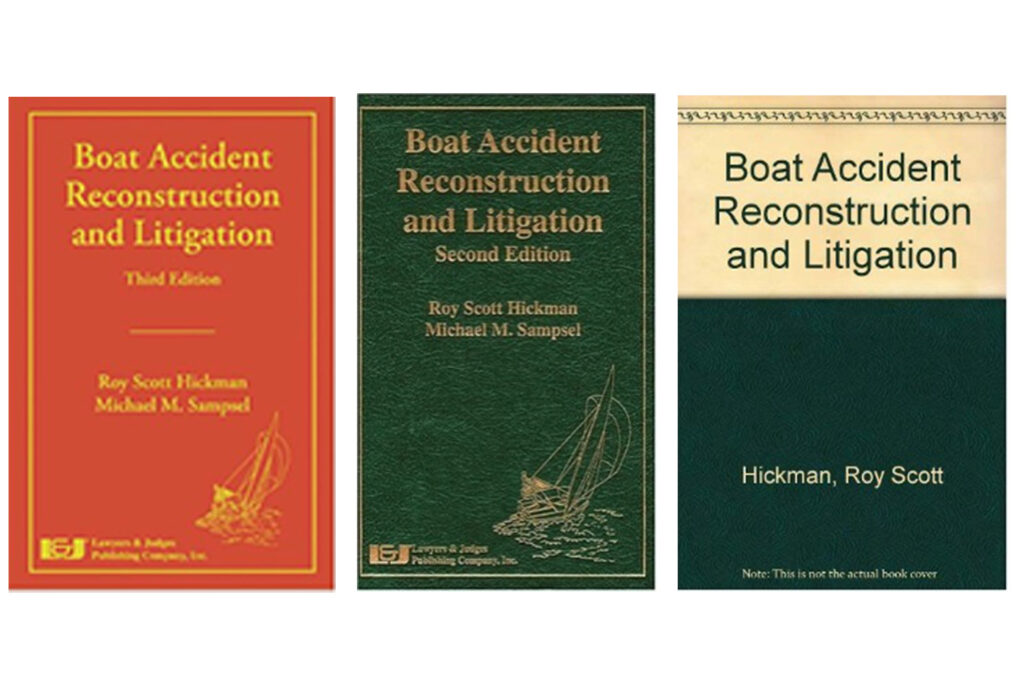
Book Review: “Boat Accident Reconstruction and Litigation” Third Edition by Roy Scott Hickman & Michael M. Sampsel, contributing authors Jeanne-Marie D. van Hemmen & Sterling Stires. Table of contents, introduction, 18 chapters with endnotes, appendices, about the authors, index, 512 pp, 6 X 9 inches, originally published in 1999, 2nd Edition in 2002, published by Lawyers & Judges Publishing Company, Inc. Tucson, Arizona, available as either hardcover textbook, PDF eBook or Kindle for $99.00.
This is the 3rd Edition of the book, revised in 2011, originally published in 1999. I have not read the first two editions. Included in the Introduction is the statement “The science of boating collisions is in its infancy when compared to automobile accidents.” This seems to set the stage for much of the book as so much of the information is either out of date or has not been updated, even to 2011 standards. The most recent Endnotes for each chapter, which includes pertinent publications and case law references, are from 2011, nothing more current. Much of the missing and outdated information can be found easily through the USCG, USCGAUX, State and NASBLA websites.
At first, I was going to address issues, both good and bad, for each of the 18 chapters, which cover 302 of the 512-page tome. The final 210 pages are Appendixes A through G, which include: Selections from Title 46, U.S. Code, COLREGS, Inland Rules, U.S. Coast Guard Operating Regulations, Useful Publications and Boating-Related Organizations. More current information is available than what is provided here.
Instead, because there so many, I will just touch on some highlights. For example, in Chapter 2 Nautical Terminology, some old, incorrect and/or out of date terms are used, such as:
- Give-way vessel (burdened) – The boat that must stay clear of vessels that have the right-of-way.
- Right-of-way – The right and duty to maintain course and speed. (Conflicts with Rule 8)
- Stand-on vessel – (privileged) The vessel with the right-of-way.
See Rules 9 (a) (ii) and Rule 14 (d), which are the only times “right of way” are used. The terms “Burdened” and “Privileged” were discarded in the 1972 COLREGS.
The authors continually and incorrectly use the term “right-of-way” throughout indicate a lack of understanding of the NAVRULES. Some states do use this term for sole state waters. In Chapter 3 Boats and Boat Operation; “Obviously, a sailboat is not as maneuverable as a powerboat, and this is why it usually has the right-of-way over powerboats.” Rule 13 Overtaking and Rule 9 (b) Narrow Channels could have been referenced here for better understanding as to why they say “usually”.
There are other terms that I found lacking complete descriptions as well, such as “Trim – To arrange weights or adjust trim tabs on a vessel in such a manner as to obtain desired draft at bow and stern. Also to adjust sails to take better advantage of the wind direction.” On small recreational boats the most common way to obtain proper trim is to direct the passenger seating, which corrects for any undesired side-to-side listing. This is not mentioned.
“Danger Zone”, while not used in the NAVRULES is used by some States. The common term “Sterndrive” is not included in the description of Inboard/Outboards. Finally, many of the Maritime Law terms referenced in Chapter 5 Recreational Boating Law such as in rem, quasi in rem and Pro hac vice are not defined anywhere. These highlight the challenge of writing for multiple and vastly different target audiences, such as lawyers, engineers, LEOs and accident investigators.
Due to the age of this book and lack of a newer edition, some issues are obsolete, or newer terms are now in use. There is discussion about the “new” four-stroke engines “of up to 300 hp”. Today, the new Mercury Verado V12 is rated at 600 horsepower, and “Large boats (over 20 feet long) sometimes have two outboards mounted side by side on the transom for maximum power.” Many of today’s high-performance boats now have 4, 5 and even 6 O/Bs.
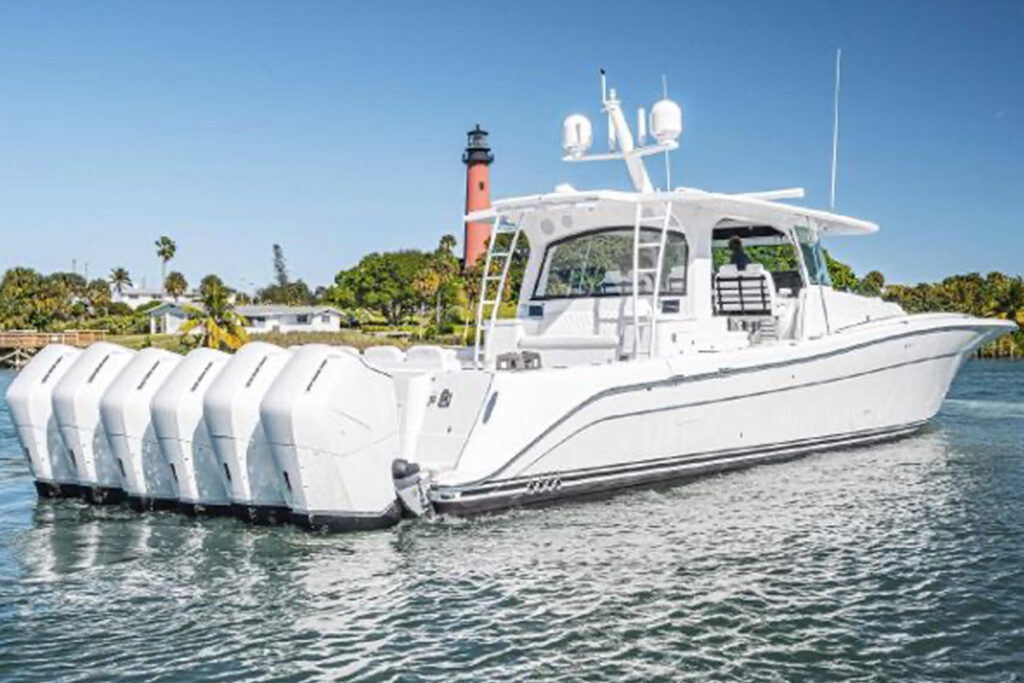
Six 600 horsepower Outboards providing 3,600 horsepower are not that uncommon.
This is the 65′ HCB Estrella with 6,600HP V12s priced at $5M
There is now new labeling for both PFDs and fire extinguishers, and “PWC safety lanyards”, now officially called “ECOS – Emergency Cutoff Switches”, are now required on many new boats and must be attached to the operator. Inflatable PFDs had just recently been introduced at the time of publication. “The design and approval of less restrictive and more compact, inflatable PFDs may lead to wider acceptance.” Most agencies now require marine officers to wear inflatable PFDs.
Some statements are just wrong. “All boats must have a U.S. Coast Guard approved fire extinguisher onboard…” (not boats of open construction), and “Other required equipment includes visual distress signals, anchor and anchor line, paddle and a whistle or other sound producing device.” Some states do have additional requirements, such as a dewatering device, but these blanket statements are not universal. NASBLA is a great source to determine what is required for each state.
In “Accident Reporting” requirements, the authors initially fail to highlight a death, insinuating reports are only required if a person disappears. You can have a death without a disappearance.
“Years ago, most boats were left hand drive. Today that tradition is still with us as most lake traffic and waterskiing around a course is counterclockwise.” At the bottom of this paragraph, we see “Many boat manufacturers now place the operator station on the starboard or right-hand side to help counter the right-hand torque of the single propeller.” Historically, boats were steered from the steering board, ne starboard, and more importantly, a starboard helm provides better visibility of approaching vessels from the side that you must yield to other vessels per the NAVRULES.
Some basic safety procedures are missing. “If a boater is caught in heavy weather she should reduce speed and proceed with caution while heading for the nearest safe haven”. No mention of donning PFDs!
On education and licensing. “The debate in state legislatures continues.” Only a few states do not require boater education today. There is minimal information on Fires and Explosions or Electroshock drowning. The term “Stressors” had not been coined yet. This is the fatigue due to boating while being exposed to sun, glare, motion, noise, vibration, wind, etc.
There are some good and interesting sections, such as PWC history, Admiralty Law, propellor guards, fluid mechanics, carbon monoxide poisoning, Attorney-Expert Relationship, and boat versus vehicle accident comparisons. For engineers, the Accident Reconstruction chapter has many calculations and formulas. Any reconstructionists using these calculations should be able to properly explain what they mean.
There is no information on report writing or first responder duties for marine law enforcement officers/investigators. The black and white photographs look like many are from the 1960’s.
To summarize, the First Edition published in 1999 may have been relevant when initially made available and prior to wide use of the internet, but due to new technology, changes to boating laws and information now readily available online, even the most recent Third Edition has little value, as it has not been updated to reflect the times. More current and comprehensive information can be found for each of the 18 Chapters on the internet or in books dedicated specifically to the subject matter. For those interested in adding more books to their library on the past and outdated history of boating safety marine accident investigation it may be considered.
A marine accident investigator and reconstructionist finding the opposing “expert” referring to this manual will have plenty of comments for their rebuttal report.
My next review shall be of the NASBLA National Boating Accident Investigation Field Guide, Fourth Edition. This is the manual you should be using.
By CAPT Mark S. Poster, CMI